


Population ecology and dispersal
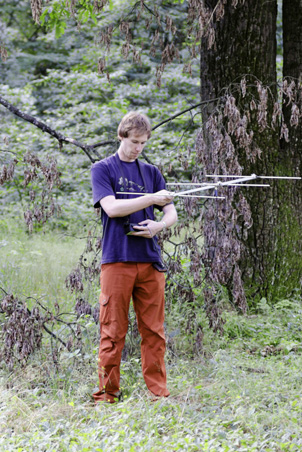
Habitat fragmentation threatens especially species with poor dispersal abilities, as their isolated, small populations are prone to extinction as a result of environmental, demographic and genetic stochasticity. Studying animal movement and demographic parameters thus become important issues in conservation biology and landscape management. There are several methods how to assess the dispersal. In our studies, we have employed direct methods (mark-release-recapture and radio-tracking) providing us the information about the real dispersing individuals. Such methods can be further used to obtain information about the beetles’ demography (MRR) or even behavior (radio-tracking). So far, we have focused on species of Rosalia alpina and Carabus hungaricus for which multi-year MRR studies were done. Currently, we assess different aspects of the biology of Cerambyx cerdo using the radio-tracking technique. We believe that despite the certain methodological drawbacks of each method, our results can still provide novel information about these strictly protected species of beetles.
Members involved
Lukáš Drag, Lukáš Čížek
Related publications
- Drag L., Cizek L. (2018) Radio-Tracking Suggests High Dispersal Ability of the Great Capricorn Beetle (Cerambyx cerdo) Journal of Insect Behavior 31: 138–143.
- Elek Z., Drag L., Pokluda P., Čížek L., Bérces S. (2014) Dispersal of individuals of the flightless grassland ground beetle, Carabus hungaricus (Coleoptera: Carabidae), in three populations and what they tell us about mobility estimates based on mark-recapture. European Journal of Entomology 111: 663-668.
- Drag L., Hauck D., Pokluda P., Zimmermann K., Čížek L. (2011) Demography and Dispersal Ability of a Threatened Saproxylic Beetle: A Mark-Recapture Study of the Rosalia Longicorn (Rosalia alpina). PLoS One 6: e21345.