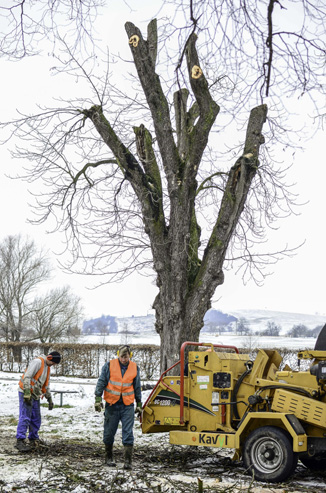
Our studies often deal with conservation of woodland associated insects and their biodiversity, predominantly in temperate forests of low or middle elevations. We explore how different forest managements affect diversity and composition of insect communities, mainly those of saproxylic beetles, but also butterflies, moths, bees and wasps or other groups. We are particularly interested in the management of protected woodland areas where biodiversity conservation is the primary objective. We try to evaluate costs and benefits of non-intervention vs. active intervention approach. Due to a spontaneous development taking place in most of the protected forests, formerly biologicaly rich open or semi-open woodlands have become shady closed-canopy forests leading to a rapid decline in number of light-demanding and often specialized species. Our studies indicate that conservation management should aim at opening the canopy and diversifying structure of the protected forests. In this context, we often show that traditional silvicultural practices, such as coppicing, wood-pasture or pollarding, may serve as useful tools in conservation and ecological restoration of temperate woodlands.
Members involved
Pavel Šebek, Lukáš Čížek, Michal Perlík, Petr Kozel, Lucie Ambrožová
Related papers
Life after fire: how saproxylic organisms thrive in burnt forests.Moro G. et al. 2026, Fire Ecology.
Recovery after extirpation of an invasive tree? Effect of black locust (Robinia pseudoacacia) removal on soil, vegetation and saproxylic beetles.Lanta V. et al. 2026, Journal of Environmental Management.
Plant colonisation, soil nutrient patterns and microclimate after a large forest fire in temperate Central Europe.Lanta V. et al. 2025, Forest Ecology and Management.
Artificial tree microhabitats: Wound depth and position affect saproxylic beetles attracted to freshly veteranised trees.Cizek L. et al. 2024, Insect Conservation and Diversity.
A synthesis of multi-taxa management experiments to guide forest biodiversity conservation in Europe.Tinya F. et al. 2023, Global Ecology and Conservation.
N equals two (times five). Exploring the effects of horse rewilding on five congeneric adult butterflies.Hájková K. et al. 2023, Journal for Nature Conservation.
Not invasive status but plant overstory matters: open shrub canopies support greater plant and arthropod diversity and more complex food web structures compared to shady tree canopies.Lanta V. et al. 2023, Arthropod-Plant Interactions.
Canopy openness as the main driver of aculeate Hymenoptera and saproxylic beetle diversity following natural disturbances and salvage logging. Perlík et al. 2023, Forest Ecology and Management
Multifaceted diversity changes reveal community assembly mechanisms during early stages of post-logging forest succession.Lanta et al. 2023, Plant Ecology
Windthrow and salvage logging alter β-diversity of multiple species groups in a mountain spruce forest.Georgiev K.B et al. 2022, Forest Ecology and Management
Restoring diversity of thermophilous oak forests: connectivity and proximity to existing habitats matter.Lanta et al. 2020, Biodiversity and Conservation
Estimating retention benchmarks for salvage logging to protect biodiversity.Estimating retention benchmarks for salvage logging to protect biodiversity. Thorn et al.,2020, Nature Communications
Active management promotes plant diversity in lowland forests: A landscape-scale experiment with two types of clearings.Lanta et al. 2019, Forest Ecology and Management.
Open-grown trees as key habitats for arthropods in temperate woodlands: The diversity, composition, and conservation value of associated communities.Šebek et al. 2016, Forest Ecology and Management.
Does a minimal intervention approach threaten the biodiversity of protected areas? A multi-taxa short-term response to intervention in temperate oak-dominated forests.Šebek et al. 2015, Forest Ecology and Management.
Erasing a European biodiversity hot-spot: Open woodlands, veteran trees and mature forests succumb to forestry intensification,succession, and logging in a UNESCO Biosphere Reserve.Miklín and Čížek 2014, Journal for Nature Conservation.
Is active management the key to the conservation of saproxylic biodiversity? Pollarding promotes the formation of tree hollows.Šebek et al. 2013, PLoS ONE.