Šumava National Park was established in 1991. It covers an area of ~685 km2 which makes it the largest national park in the Czech Republic. In SW it has a common border with the Bavarian Forest National Park (Germany); together they represent the largest continuous forest area in Central Europe.
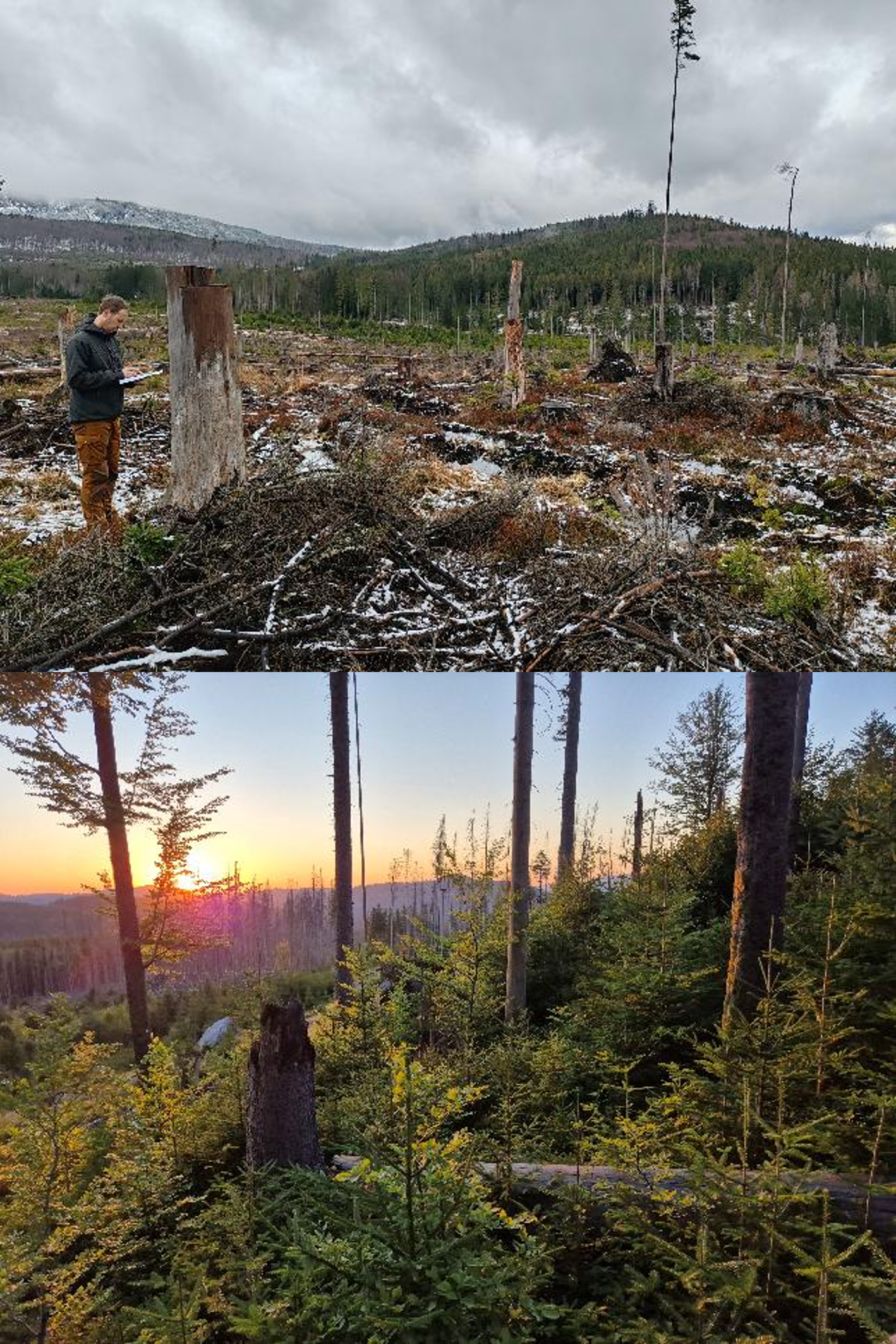
Forests cover the greater part of the territory of Šumava NP, making up as much as 80% of the total area. The most significant types of forests are alpine spruce forests and eutrophic and acidophilous beech forests. The other important biotopes include meadows and pastures, wetlands (esp. peat bogs), or rock fields.
Šumava NP comprises unmanaged core areas (~23%), as well as more intensely managed zones where salvage logging is a common practice. The park was subject to two severe windthrow events followed by bark beetle infestations in 1996–2000 and 2005–2009. In our study we thus focus on how these historical processes influenced the distribution and occurrence of endangered saproxylic beetles as well as the response of the entire beetle communities to various types of interventions implemented in previous years.
Biology Centre CAS Institute of Entomology Branišovská 31 370 05 České Budějovice Czech Republic