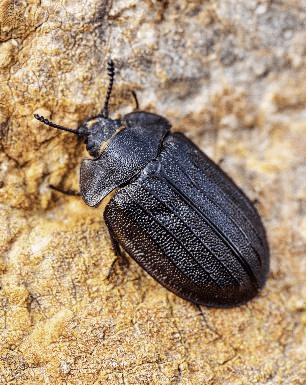
This rare beetle is associated with well-preserved, old-growth forest stands, particularly in submontane and montane areas. In the Czech Republic, it occurs mainly in two areas: southern Bohemia (e.g., Šumava) and eastern Moravia (e.g., Jeseníky, Beskydy).
Aduls can be found both in day and night – during the day, they remain hidden under bark, while at night they usually sit on the underside of various fungi (often Fomitopsis pinicola). Both adults and larvae inhabit dead, still-standing trunks or stumps of deciduous trees, but mainly coniferous trees attacked by wood-decaying fungi. Larval development lasts three years, and a new generation of adults emerges in autumn. Adults create characteristic, wide oval exit holes in the wood.
In the Czech Republic, this beetle is classified as critically endangered according to the Red List of Threatened Species. The species is threatened by inappropriate forest management, particularly by the loss of native, well-preserved montane forests of the beech–fir zone with a sufficient amount of dead wood.
Our team focuses on its habitat requirements, phylogeography, and population genetic structure in order to better understand its evolutionary history and to propose effective conservation measures.